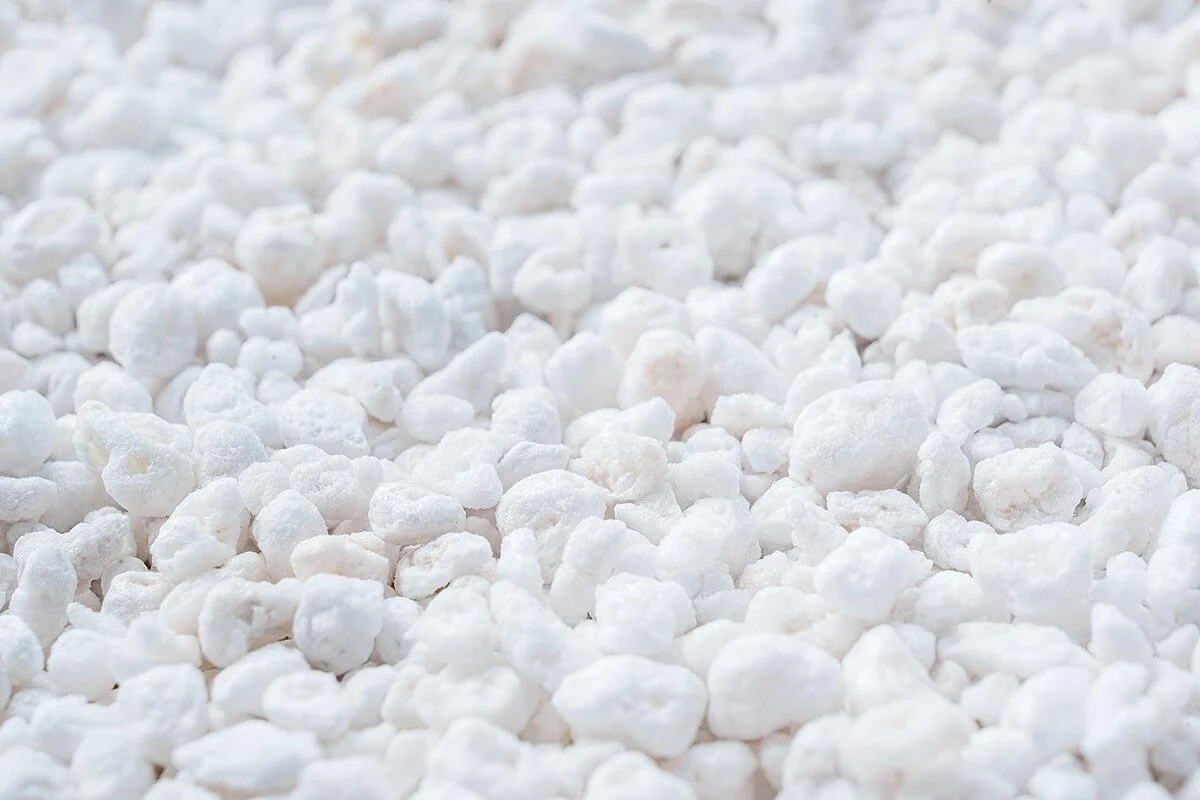
Perlite is a lightweight, amorphous volcanic glass that expands when rapidly heated to produce a white, porous material. It is widely used in horticulture, mushroom cultivation, and hydroponics because of its excellent water retention, aeration, and drainage properties.
Origin and processing
Source: Perlite is a natural volcanic glass high in silica.
Expansion: Raw perlite is crushed and heated to about 1,400–1,800°F (760–980°C). The trapped water in the glass vaporizes, causing the particles to "pop" and expand up to 4–20 times their original volume. The expanded product is airy and has a popcorn-like structure.
Grades: Available in multiple grades (fine, medium, coarse) determined by particle size and intended use.
Physical properties
Appearance: White, lightweight, and brittle with a granular, porous structure.
Bulk density: Very low (typically 30–150 kg/m³ depending on grade).
pH: Generally neutral to slightly alkaline (around 7–8.5).
Inertness: Chemically inert and sterile in its expanded form; does not decompose.
Horticultural uses
Soil amendment: Improves soil structure by increasing aeration and drainage while retaining some moisture and nutrients near roots.
Potting mixes: Commonly mixed with peat, coco coir, or compost to create well-draining potting substrates.
Seed starting and cuttings: Fine-grade perlite provides good moisture retention and oxygenation for root development.
Hydroponics and soilless culture: Used alone or blended as a soilless medium for containerized growing.
Mushroom cultivation
Sterile barrier: Used in the moisture reservoir of mushroom grow boxes or monotubs to maintain high humidity.
Substrate component: Mixed into bulk substrates or casing layers to improve aeration and prevent compaction.
Practical considerations
Dust: Dry perlite can generate fine dust; wetting before use or wearing a dust mask helps reduce inhalation risk.
Handling: Lightweight and easy to dispense; not a source of nutrients—works by modifying physical properties of the growing medium.
Disposal: Inert and safe for disposal in regular waste streams; can also be reused if kept clean and free of pathogens.
Perlite is a lightweight, amorphous volcanic glass that expands when rapidly heated to produce a white, porous material. It is widely used in horticulture, mushroom cultivation, and hydroponics because of its excellent water retention, aeration, and drainage properties.
Origin and processing
Source: Perlite is a natural volcanic glass high in silica.
Expansion: Raw perlite is crushed and heated to about 1,400–1,800°F (760–980°C). The trapped water in the glass vaporizes, causing the particles to "pop" and expand up to 4–20 times their original volume. The expanded product is airy and has a popcorn-like structure.
Grades: Available in multiple grades (fine, medium, coarse) determined by particle size and intended use.
Physical properties
Appearance: White, lightweight, and brittle with a granular, porous structure.
Bulk density: Very low (typically 30–150 kg/m³ depending on grade).
pH: Generally neutral to slightly alkaline (around 7–8.5).
Inertness: Chemically inert and sterile in its expanded form; does not decompose.
Horticultural uses
Soil amendment: Improves soil structure by increasing aeration and drainage while retaining some moisture and nutrients near roots.
Potting mixes: Commonly mixed with peat, coco coir, or compost to create well-draining potting substrates.
Seed starting and cuttings: Fine-grade perlite provides good moisture retention and oxygenation for root development.
Hydroponics and soilless culture: Used alone or blended as a soilless medium for containerized growing.
Mushroom cultivation
Sterile barrier: Used in the moisture reservoir of mushroom grow boxes or monotubs to maintain high humidity.
Substrate component: Mixed into bulk substrates or casing layers to improve aeration and prevent compaction.
Practical considerations
Dust: Dry perlite can generate fine dust; wetting before use or wearing a dust mask helps reduce inhalation risk.
Handling: Lightweight and easy to dispense; not a source of nutrients—works by modifying physical properties of the growing medium.
Disposal: Inert and safe for disposal in regular waste streams; can also be reused if kept clean and free of pathogens.